

Wincos
Company Industry :
Automotive & Building Materials
Challenge
- Wincos was still using manual attendance processes through paper forms and fingerprint machines, requiring additional recapitulation and offering limited flexibility for employees.
- The approval process for leave and reimbursement depended on the availability of supervisors, which could delay requests when supervisors were out of the office.
- The use of fingerprint machines also made attendance recording less practical, as employees had to reach the machine first even when they had already arrived within the office premises.
Solution
- Wincos implemented Axdif to digitalize attendance, leave requests, reimbursement, and supervisor approvals, enabling employee administration to be managed more flexibly through a single system.
- Wincos improved the accuracy and efficiency of attendance administration by replacing manual attendance recording and calculations with a more structured and easily monitored digital system based on location radius.
- Through Axdif's digital approval system, supervisors can provide approvals from various locations, allowing leave and reimbursement requests to be processed without depending on the supervisor's physical presence in the office.
Digitalizing Attendance and Approval Processes to Improve the
Flexibility of Employee Administration at Wincos
Overview
In managing employee administration, Wincos previously
relied on manual processes for several HR activities,
particularly attendance recording and approval
processes.
Before implementing Axdif, attendance was recorded using
paper forms. Employees were required to manually write down
their clock-in and clock-out times, after which the data was
collected and manually accumulated for administrative
purposes.
This process involved multiple steps in managing attendance
data. In addition to manual recording, the relevant team also
had to compile the data to ensure that each employee's
working hours were recorded correctly.
Wincos also previously used fingerprint machines as an
attendance method. Although they could be used to record
employees' presence at the office, the usage of fingerprint
machines made the attendance process dependent on the
physical location of the device and provided limited
flexibility for employees.
In addition to attendance, administrative processes such as
leave requests and reimbursement also required approval from
supervisors. When these processes still depended on forms and
manual approval, employees had to wait for their supervisors
to be available before their requests could be
processed.
This situation could prolong administrative processes,
particularly when supervisors were out of the office or
unable to provide approval in person.
Mobile Attendance and Digital Approval for More Flexible
Administration
Axdif helped Wincos transform employee administration
processes that were previously handled manually into a more
digital, structured, and flexible system.
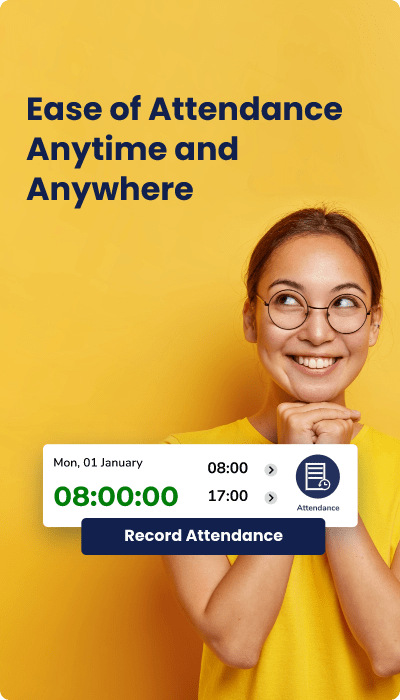
One of the most noticeable improvements was the attendance
process. After implementing Axdif, employees were no longer
dependent on paper forms or fingerprint machines. Employees
could clock in using their mobile devices as long as they
were within the attendance radius determined by the
company.
This flexibility provides greater convenience in employees'
daily activities. For example, employees can record their
attendance once they are within the office area without
having to first reach a fingerprint machine.
This usage also helps reduce the risk of employees being
recorded as late simply because they had to find a parking
space before reaching the attendance machine.
In addition to attendance recording, leave and reimbursement
requests became easier because they could be submitted
through Axdif. Employees can manage these administrative
requirements through the same system without relying on paper
forms.
The approval process also became more flexible. Supervisors
can provide approvals through Axdif even when they are not in
the office. As a result, all requests have never been delayed
because a supervisor can decide it in many different
locations.
This digitalization makes administrative workflows between
employees, supervisors, and the HR team more practical while
helping reduce dependence on manual processes.
More Structured and Accurate Attendance Administration with
Axdif
Another improvement experienced by Wincos after implementing
Axdif was a more organized approach to attendance
administration.
Previously, employees' clock-in and clock-out times were
recorded using forms and then manually accumulated. This
process required additional administrative work while also
creating the possibility of errors during data
compilation.
After attendance processes were managed through Axdif,
attendance information could be recorded digitally, making
the data more structured and accurate. The team responsible
for employee administration no longer had to rely entirely on
paper-based records to track attendance times.
The implementation of a radius-based system also provides a
balance between flexibility and company control. Employees
have the convenience of recording attendance through their
mobile devices, while clock-ins are still limited to areas
determined by the company.
Beyond attendance, the ease of submitting leave requests,
reimbursement claims, and approvals allows various employee
administrative activities to be managed more simply within a
single system.
For supervisors, this flexibility allows approvals to be
granted whenever they are needed without having to wait until
returning to the office. For employees, the submission
process becomes more practical because it no longer relies on
physical documents and face-to-face processes.
Overall, the implementation of Axdif has helped Wincos
transition from form-based administration and fingerprint
machines to a more mobile and integrated system. With simple
and more flexible administrative processes, Wincos can reduce
its dependence on manual processes while creating a more
practical and efficient employee administration
experience.
Share


Read More Case Studies


















© . Axdif.
All Right Reserved.



Contact
Contact Us
Talk to Us
[email protected]

Malaysia
T2-L9-1 & 3, Level 9, IOI City Tower 2, Lebuh IRC, IOI
Resort City, 62502 Putrajaya
Indonesia
Pusat Bisnis Thamrin City Lt. 7, Jl. Thamrin Boulevard,
Jakarta 10230
Philippines
Unit 1604, Antel Corporate Center 121 Valero St, Salcedo
Village 1227 Makati City
Thailand
973, Unit 8B, 8th Floor, President Tower, Phloen Chit
Road, Lumphini, Pathum Wan, Bangkok 10330
Singapore
Level 39, Marina Bay Financial Centre Tower 2,10 Marina
Boulevard, Singapore 018983
Find Axdif On Social Media


© . Axdif.
All Right Reserved.